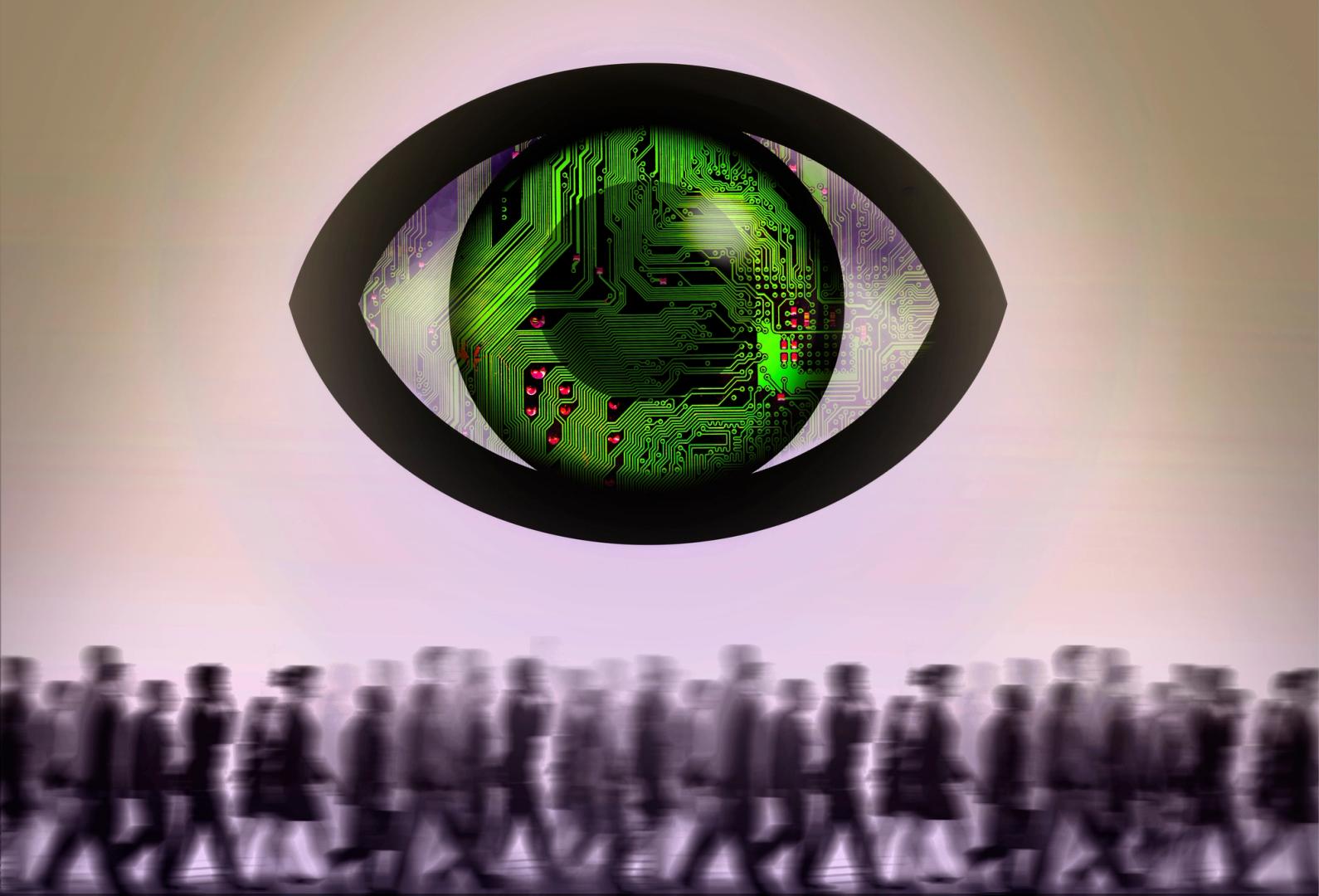
Recent reporting has revealed that the U.S. Department of Homeland Security (DHS) has been aggregating data of Americans’ financial activities to analyze and then provide local law enforcement with tips on potential criminals. This practice — known as predictive policing — is inherently authoritarian. It completely depends on mass surveillance to aggregate and analyze enough data to then determine whether or not you could be a criminal in the eyes of the state.
Here’s the problem: information tells a story and says whatever its narrator wants it to say, which is then used to justify subsequent actions. The state — as the collector of your data — is the narrator of your story. It determines which dots get connected and which picture gets painted about you. That’s ripe for abuse because anyone can take massive amounts of information and cherry-pick it to convey anything they want and then act on it.
In the words of Cardinal Richelieu, “If you give me six lines written by the hand of the most honest of men, I will find something in them which will hang him.”
For predictive policing, law enforcement watches your every move to determine if you might be a criminal and then goes after you for it. With this current situation, part of this predictive policing is based on financial surveillance of the American people, meaning your transaction history is essentially treated as evidence before you’ve done anything wrong. This is deeply un-American and unconstitutional. Here, you are far from innocent until proven guilty; here, you are always a suspect that the state is always prepared to prosecute.
The clearest example is of Kyle William Olson, whose traffic stop in Montana was instigated by a Border Patrol Predictive Intelligence Targeting Team (PITT). A DHS memo produced in his criminal case and shared with 404 Media said the team had identified “financial activity patterns commonly associated with illicit narcotics activity,” but did not explain which records it examined or how it obtained them. Police ultimately found marijuana in Olson’s vehicle, but that discovery does not resolve the underlying question: why was the government secretly analyzing his finances before officers had identified a specific crime?
And the other examples provided by 404 Media illustrate this well. Americans are pulled over and questioned based on information provided to local law enforcement from the DHS. One of the victims, Alek Schott, was pulled over for allegedly drifting between lanes and had his truck searched for drugs, but none were found. The Associated Press reported that federal agents monitored Schott’s travel patterns through license-plate scans and other surveillance technologies. Schott is now suing Bexar County, as well as the sheriff and some deputies, for violating his Fourth Amendment rights — and rightfully so.
As the Institute of Justice put it, “Police must have a fact-based suspicion of a crime before making a stop, a valid reason to extend that stop, and either a warrant, consent, or an objective reason to believe there’s contraband inside to search a vehicle. In Alek’s case, the deputy failed to meet any of these criteria and instead used an unjustified traffic stop to probe into crimes Alek hadn’t committed.”
These two cases raise several questions. Where did law enforcement get these suspicions of a crime? Like the other stops reported by 404 Media, evidence suggests DHS Border Patrol instigated the stops. How does DHS obtain various forms of data on these Americans in the first place?
For financial data, the Financial Crimes Enforcement Network (FinCEN) — the agency within the Department of Treasury in charge of overseeing compliance with the Bank Secrecy Act (BSA) — could be the culprit. The BSA requires financial institutions to maintain records and report certain large or suspicious transactions to the government to detect and prevent money laundering and other illicit activities. FinCEN then shares this information with other federal agencies in order to carry out regulatory duties — which is likely where the DHS received this information.
And the information is expansive. Financial institutions have a pattern of over-reporting to mitigate any risk of non-compliance. Hence, suspicious reporting is rampant and FinCEN collects an abundance of information on Americans’ financial activities.
However, these practices do not make Americans safer. Far from it. Financial transactions act as confessions about your beliefs, associations, and desires — intimate details that are often the reason for discrimination. This is not a hypothetical. Financial surveillance and censorship have long existed in both Western Democracies and authoritarian regimes to identify and silence political dissidents.
In 2022, Canadian Prime Minister Justin Trudeau leveraged emergency powers to freeze the personal and corporate bank accounts of protestors, justifying his actions under the guise of safety and security. Canada is a proclaimed liberal democracy but acted no differently than China did that same year, where WeChat banned the accounts of protestors — a deeply integrated payments and messaging application.
Source
This article is syndicated for educational reading. For the latest updates, visit the original publisher.
Read on coindesk.com