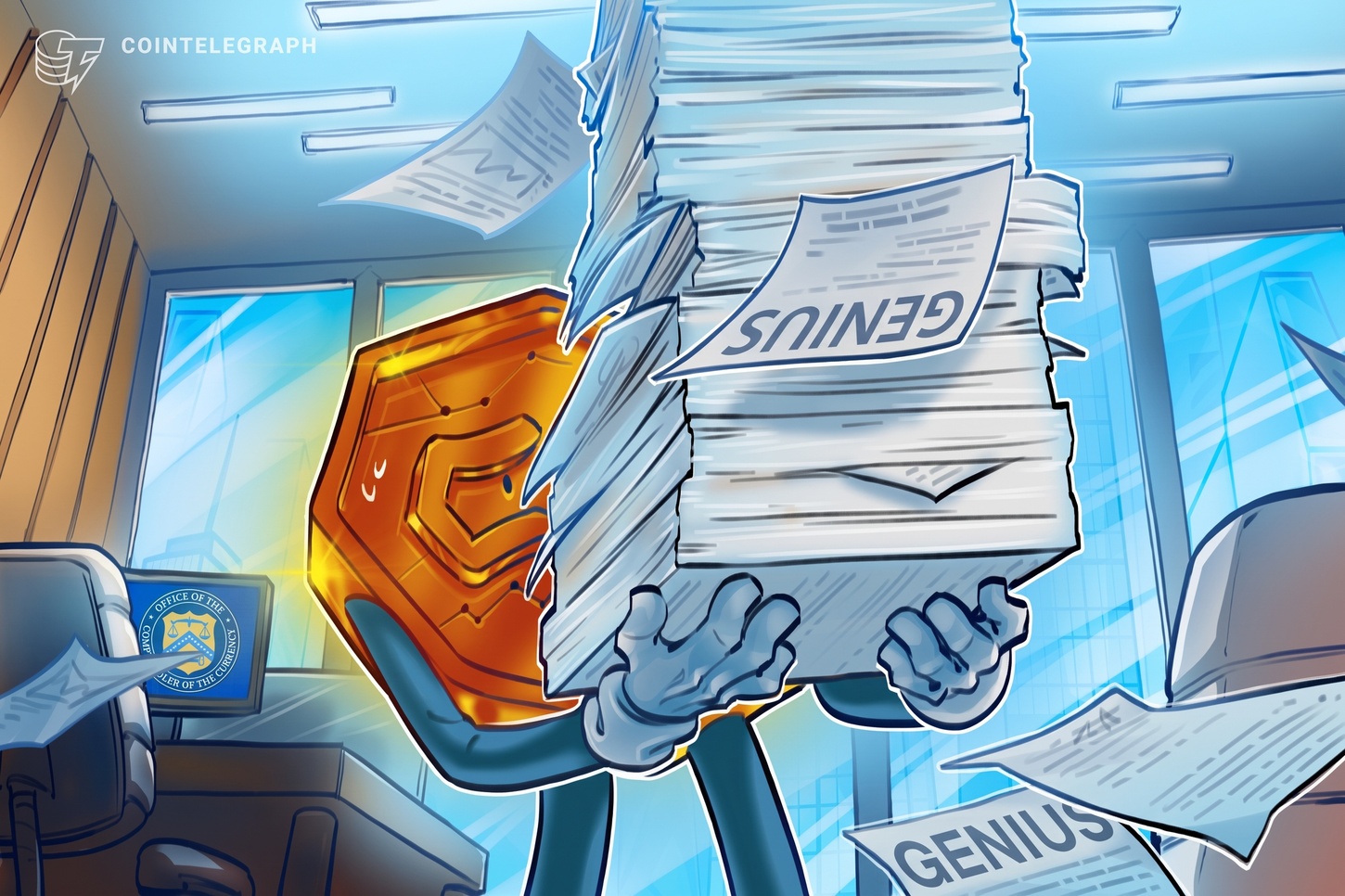
U.S. crypto exchanges that have long been giving people rewards for usings stablecoins will have to get the agency to sign off on those existing programs, according to the U.S. Office of the Comptroller of the Currency, the first federal banking regulator to issue a final rule under the Guiding and Establishing National Innovation for U.S. Stablecoins (GENIUS) Act.
The OCC, which oversees U.S. national banks and trusts that will play a central role in the issuance of stablecoins under the law, issued a final rule on Wednesday to establish the regulations under which the firms that issue the dollar-based tokens will operate — including in their third-party relationships with the exchanges on which their stablecoins change hands.
The agency — an independent bureau of the Treasury Department — has declined to offer examples or illustrations of what type of rewards operations may run afoul of the GENIUS Act, which declared that payments to customers made "solely in connection with the holding, use, or retention of such payment stablecoin" won't be allowed. The industry, which won't get any safe harbors for existing programs, will just have to test the agency's case-by-case oversight to get a better sense of the rule, which is set to go live on January 18.
The regulator said it "will apply the language of the statute to the facts and circumstances of any particular arrangement." However, the agency did suggest that the word "solely" in the prohibition is carrying a lot of weight, and that a reward that "might be made, at least in part, for other reasons" would fall outside the ban in the GENIUS Act.
Payment stablecoins hew to the value of the U.S. dollar and are designed — as suggested by the name — to maintain a steady value in a crypto industry in which other assets are known to be famously volatile. The sector is currently led by Tether's USDT and Circle's USDC, but a number of entrants have begun crowding into the space.
Wednesday's extensive rule establishes the start-to-finish process for regulated firms and foreign companies to issue stablecoins in the U.S. and for how firms will keep custody of them. But the rule is also meant to operate alongside a number of similar rules still being worked on by other agencies, and this effort leaves aside the Bank Secrecy Act components that will be handled by other arms of the Treasury.
"The OCC’s final rule carries that landmark legislation forward, providing a clear, practical foundation for private-sector innovation, competition, and American leadership in digital assets,” said Secretary of the Treasury Scott Bessent in a statement.
But the questions of yield have long swirled at the center of stablecoin regulation.
A number of financial firms, such as U.S. exchange Coinbase, have well-established rewards programs — akin to the customer incentives associated with credit card providers. Some of the highest rates are currently offered by PayPal and Kraken.
The GENIUS Act's ban on the issuers giving anything that looks like interest directly to the holders of their tokens has been a controversial topic and drew a lot of comments to the agency after its earlier proposal.
The programs have been declared by bankers to be a dangerous competitive threat to the customer deposits at the core of their business model. The banks felt so strongly about this that they lobbied to force further changes of the GENIUS Act into the later Digital Asset Market Clarity Act, and they continued fighting the point so vigorously that the Clarity Act couldn't muster unanimous Republican support when it failed to advance in a key Senate vote last month.
Without the amendments that had long been negotiated by bankers, the crypto industry, lawmakers and the White House, the unchanged GENIUS Act remains the only standard for how exchanges such as Coinbase should govern their rewards programs. Bankers who were concerned that the law's language would undermine their deposits are still stuck with that language, though bank deposits have continued to grow after the explosion of interest in stablecoins.
Source
This article is syndicated for educational reading. For the latest updates, visit the original publisher.
Read on coindesk.com