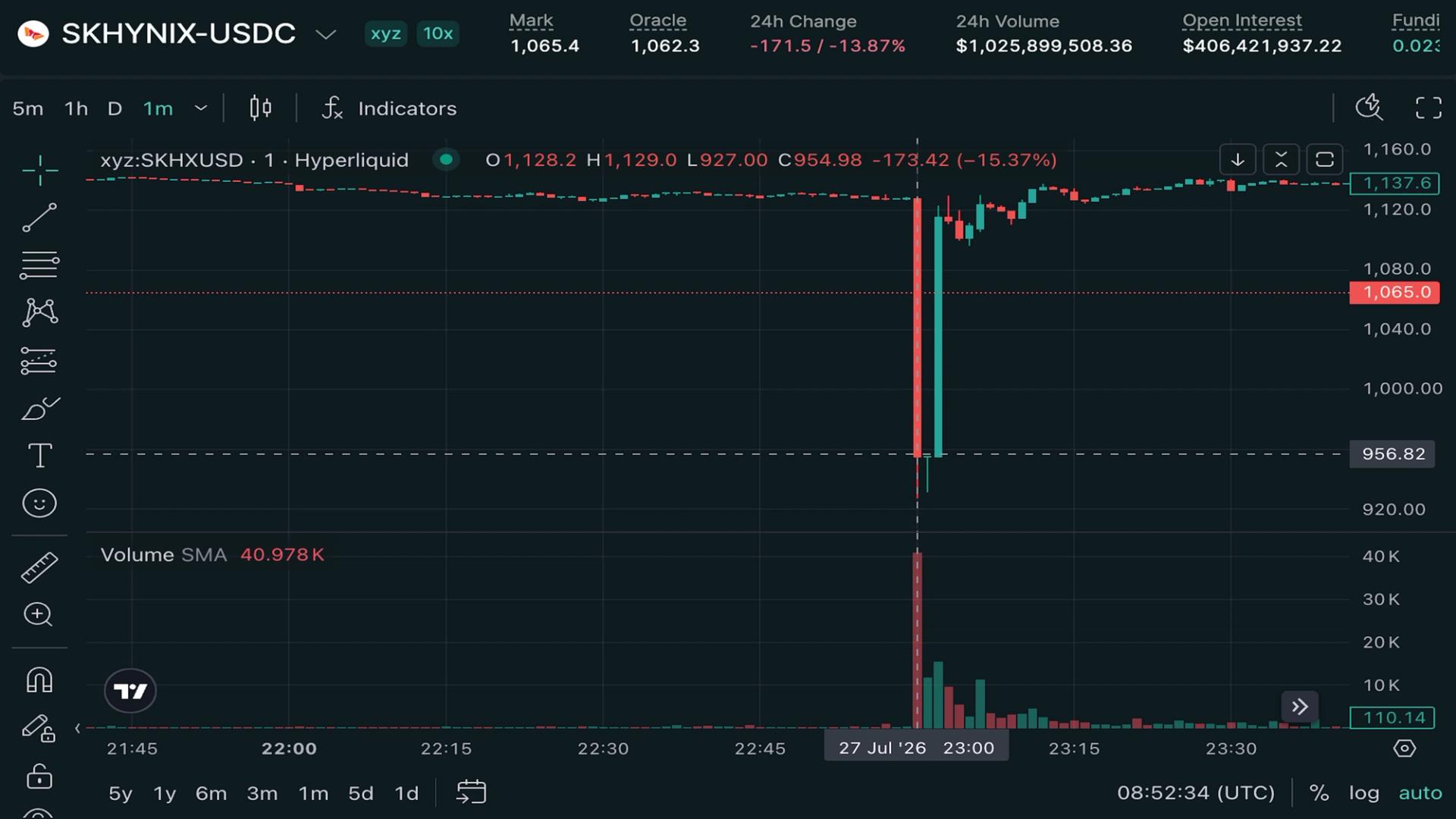
Perpetual futures tied to SK Hynix, a South Korean chipmaker whose American depositary receipts debuted on Nasdaq earlier this month, suffered a flash crash on Hyperliquid shortly before the underlying share price came under pressure in its home market.
Between 23:00 UTC and 23:01 UTC, the price of perpetuals tracking the Seoul-traded stock crashed 20% to $900, according to data from Hyperliquid. The price rebounded to over $1,000 the very next minute and was recently priced at $1,092. The contract is traded and denominated in dollar-pegged stablecoin USDC.
An hour later, the Korean stock market opened on a negative note, led by chipmakers. By the end of the day, SK Hynix shares had dropped by 15% to 1,550,000 won ($1,762). Other losers included Samsung Electronics and carmaker Hyundai Motor. The benchmark Kospi index fell 11%.
SK Hynix ADRs, 10 of which equal one share, fell 4.5% in pre-market trading to $136.51.
Hyperliquid, the leading perpetuals-focused decentralized exchange, has emerged as a hot favorite of traders looking to express their view on traditional assets, especially since the onset of the Iran war in late February. The exchange had not responded to a request for comment by publication time.
Flash crashes on crypto exchanges are quite common, especially between the U.S. market close and the opening of markets in China, South Korea, and elsewhere in Asia, because liquidity tends to be relatively thin compared with other market hours. Liquidity refers to an exchange’s ability to absorb large buy and sell orders at stable prices.
SK Hynix, one of the world’s largest suppliers of high-bandwidth memory (HBM) chips used in Nvidia’s AI processors, has taken a beating this month, falling by nearly 48% from the peak of 1,947 won reached on June 26.
It is not alone. Sentiment for AI stocks has also weakened on Wall Street. On Monday, Nvidia shares slid 5% after a Wall Street Journal report said the AI-chip maker could provide a financial backstop of about $250 billion for an OpenAI-backed data-center project.
Markets repositioned since June, but Binance held share (~55% user funds, ~24% spot) and drew net inflows in early July while the tracked market saw outflows.
Markets repositioned since June, but Binance held share (~55% user funds, ~24% spot) and drew net inflows in early July while the tracked market saw outflows.
Markets repositioned since June, but Binance held share (~55% user funds, ~24% spot) and drew net inflows in early July while the tracked market saw outflows.
Source
This article is syndicated for educational reading. For the latest updates, visit the original publisher.
Read on coindesk.com